Wild thyme — dried herb
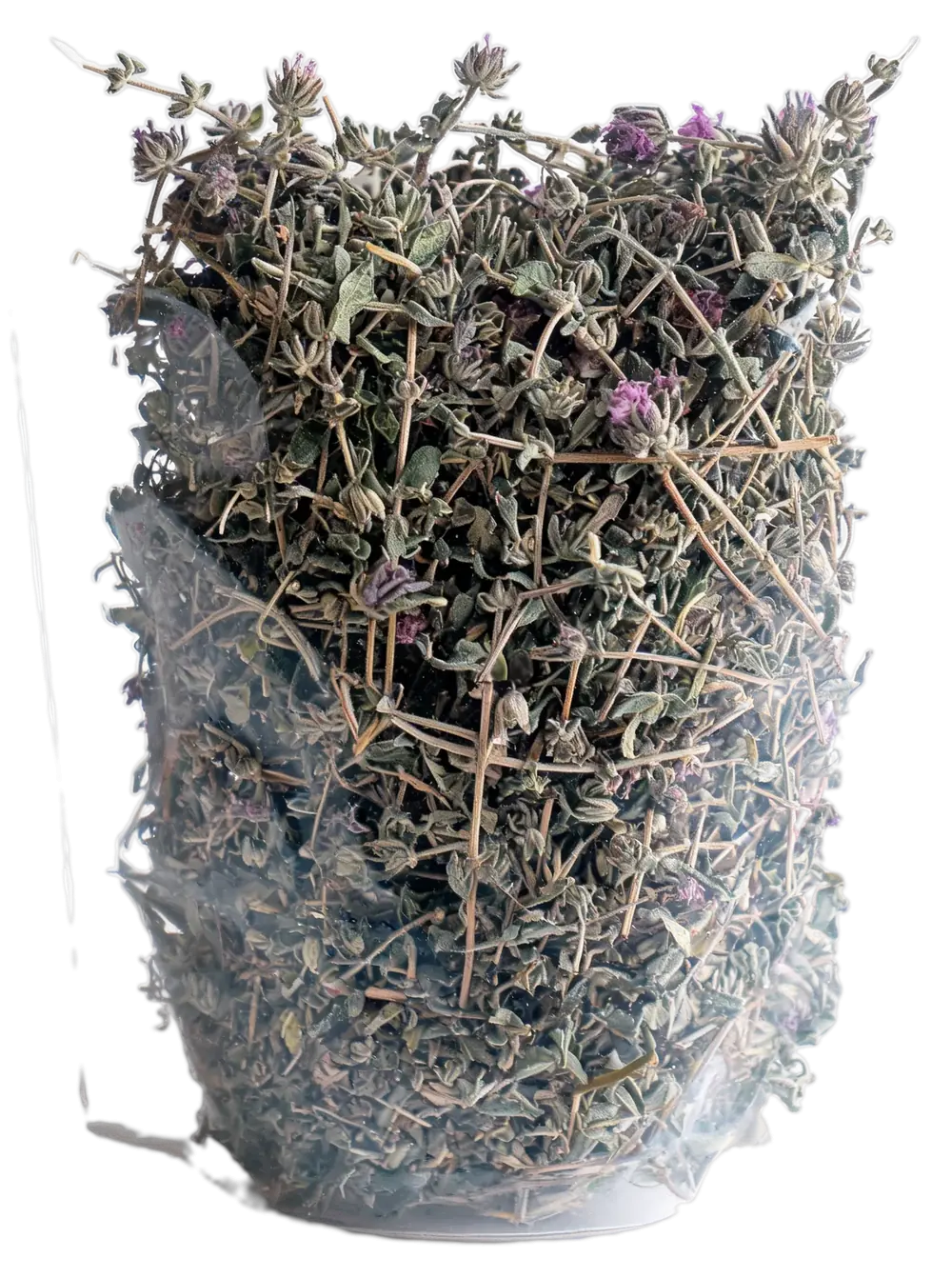
Dried flowering tops of wild thyme (Thymus serpyllum) from meadows around Čertižné in north-east Slovakia. Picked by hand, shade-dried below 35 °C.
Who we are, and why it pays to ask ahead
We are a family business from Čertižné. We pick the thyme alongside farming — and our bees belong to the same country.
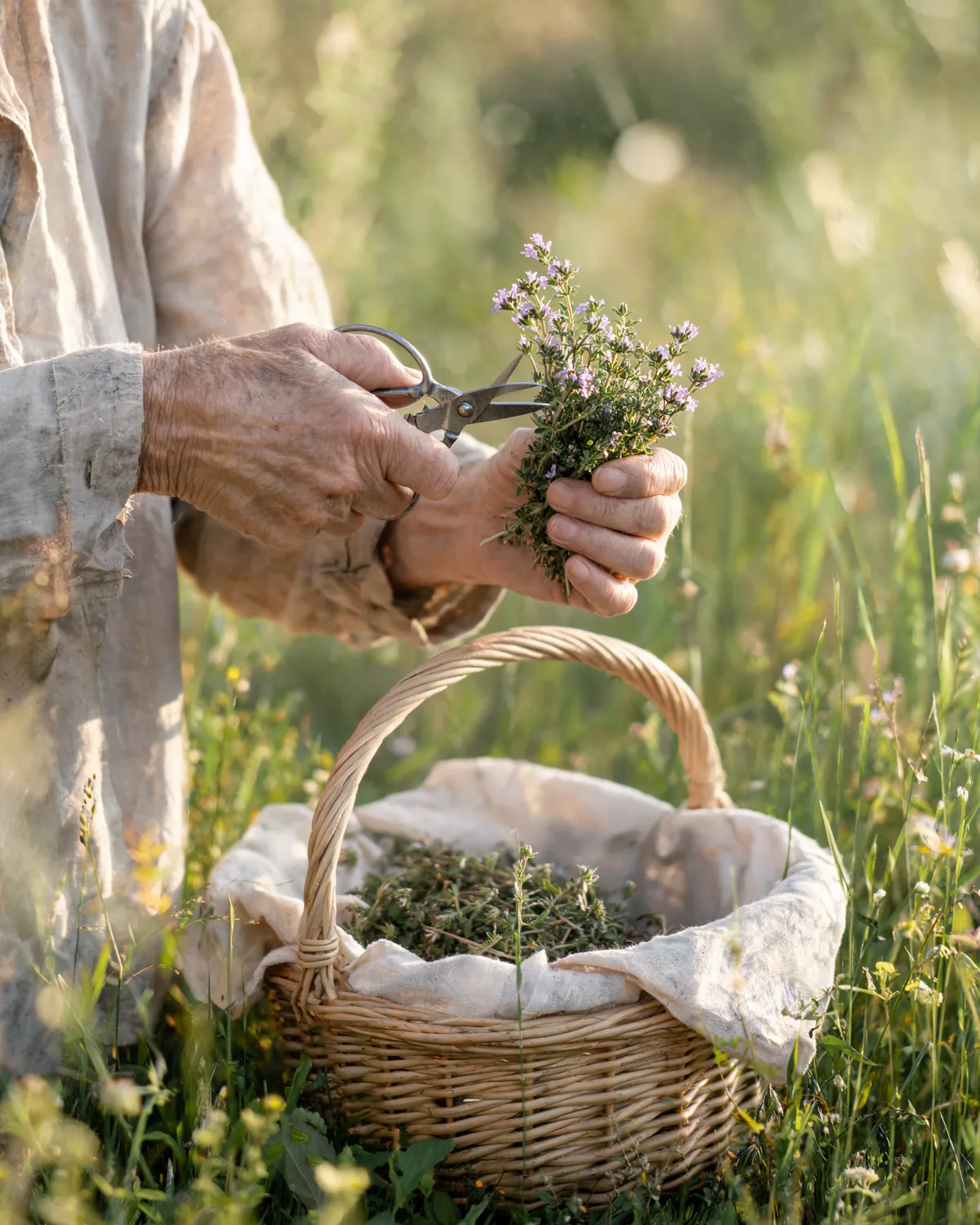
Wild thyme flowers in June and July and is picked only then. However much is gathered and dried in those two months is what there is for the whole year. The stock is therefore limited; once it runs out, the next comes only after the next flowering.
If you know you will want some, get in touch ahead of time. We will tell you what is dried right now.
Or write to info@wildthyme.eu
Composition
100 % dried wild thyme herb. Nothing else — no flavourings, no additives, no other herbs.
Food category: herbal tea. It is not a medicine and not a food supplement.
Constituents
The dried herb contains essential oil, phenolic acids, flavonoids and tannins. The share of essential oil in this species is low — a review puts it below 1 %.1.
We do not yet state figures for thymol and carvacrol content. In central European wild thyme the essential oil composition varies with locality, altitude, habitat and time of picking. Some central European populations contain neither thymol nor carvacrol as main compounds2. The only sound way to talk about content is a laboratory analysis of the actual batch. When we have one, we will publish it together with the batch number.
Brewing
| Amount | one teaspoon, about 1–2 g |
|---|---|
| Water | 250 ml of hot water |
| Time | 10–15 minutes |
| Covered | yes — covering keeps the essential oil from escaping with the steam |
Always brew it fresh. Other uses are on the Preparation page.
Storage
In a well-sealed container, dry, away from light, below 25 °C. Scent and colour show freshness: herb that has faded and stopped smelling has lost part of its essential oil.
Cautions
The points below are caution, not medical advice. A health problem belongs to a doctor, not to a cup of tea.
- Allergy. Wild thyme belongs to the mint family (Lamiaceae), like mint, lavender, oregano and sage. Do not use it if you are sensitive to this family.
- Pregnancy and breastfeeding. Targeted safety studies for this species are missing. We therefore do not recommend it without asking a doctor.
- Children under three. Not recommended, given the essential oil content.
- Amount. Digestive discomfort is reported with excessive consumption.
Origin
Meadows around the village of Čertižné, Medzilaborce district, Laborecká Highlands. More on the region page.
About the plant
Identity and classification
Thymus serpyllum L. belongs to the mint family (Lamiaceae), order Lamiales. Linnaeus described it in 1753. The lectotype was designated in 1998 by the Slovak botanists Marhold and Mártonfi.
Names
The current standard Slovak name is dúška materina (literally „mother's thyme"), older forms being materina dúška and materiná dúška. The correct word order puts the genus name dúška first; the run-together form materidúška is borrowed from Czech.
Folk names recorded in Slovak sources: žadovník (1853)3, materinka, materonka, materovka, živilka, kukučka, dúška chodec. We leave them in the original — they have no English equivalents.
Rusyn and Ukrainian names — with a reservation
In Ukrainian the genus Thymus is called чебрець (transliterated chebrets), also чабрець (chabrets), богородична трава (bohorodychna trava, „the Mother of God's herb"), материнка (materynka), жадобнік (zhadobnik), мацержанка (matserzhanka). The name comes from the root mati, mother.
A reservation worth stating plainly: these names are documented for Ukrainian in general, not specifically for Čertižné or for the Lemko dialect spoken in this corner of the Carpathians. Ethnobotanical records for the Lemko villages of north-east Slovakia are sparse in the accessible academic sources. Note also that материнка in Ukrainian more often means oregano, although an etymological dictionary confirms dialectal use for wild thyme as well.
Telling it apart
| Feature | Wild thyme | Garden thyme | Oregano |
|---|---|---|---|
| Habit | creeping, up to ~30 cm | upright subshrub, 15–30 (–50) cm | upright, 20–70 cm |
| Leaf margin | flat | inrolled | — |
| Scent | milder | sharper, more spicy | — |
| Root | one main root | fibrous, branching roots | — |
| Wild in Slovakia | yes | no, only cultivated | yes |
Oregano has similar pink-violet flowers but is markedly taller — that is the quickest way to tell them apart in the field.
Depending on the site, the stem of wild thyme may be round or square, hairy or smooth; the leaves are oval to linear and dotted with glands.
A taxonomic tangle
The genus Thymus is notoriously difficult and carries dozens of synonyms. In practice Serpylli herba is also collected from other wild Thymus species, because true T. serpyllum is not always available and the species look alike. In central and northern Europe the dominant ones are T. serpyllum and T. pulegioides, which are hard to separate. Slovak atlases list around fifteen Thymus species with Slovak names. This is why the literature writes T. serpyllum s. l. — in the broad sense.
Habitat and flowering
Sunny, dry, well-drained sites, often sandy or stony. The range is Eurasian and North African. It flowers from May to September, most often in June and July. In north-east Slovakia the suitable sites are dry meadows and pastures on the flysch slopes of the Laborecká Highlands.
Official status
The dried flowering herb is an official drug of the European Pharmacopoeia under the name Serpylli herba, which requires at least 3.0 ml of essential oil per kilogram of dried herb4. There is also a monograph by ESCOP (2014) and by the German Commission E (1987, 1990)56.
There is no separate EMA/HMPC monograph for Serpylli herba.71 Expert reviews from 2021 and 2024 agree on this. Some secondary websites claim otherwise — they are wrong. Garden thyme (Thymi herba), a different species, does have an HMPC monograph.
Sources
- Heinrich, M. a kol. (2024). Thymus serpyllum L. — a review. Frontiers in Nutrition. doi:10.3389/fnut.2024.1380962 ↩
- Bączek, K., Pióro-Jabrucka, E., Kosakowska, O., Węglarz, Z. (2018). Intraspecific variability of wild thyme (Thymus serpyllum L.) occurring in Poland. Journal of Applied Research on Medicinal and Aromatic Plants. doi:10.1016/j.jarmap.2018.11.001 ↩
- Reuss, G. (1853). Května Slovenska — ľudové názvy rastlín. Banská Štiavnica. ↩
- Európsky liekopis (Ph. Eur.) (platné vydanie). Serpylli herba — monografia drogy. European Directorate for the Quality of Medicines. www.edqm.eu ↩
- ESCOP (2014). Serpylli herba — monografia. European Scientific Cooperative on Phytotherapy. ↩
- Commission E (1987, 1990). Serpylli herba — monografia. Bundesanzeiger, Nemecko. ↩
- Feistel, B. a kol. (2021). Wild thyme (Serpylli herba) — quality and regulatory status. Planta Medica (Thieme). doi:10.1055/s-0041-1731495 ↩